


Hey there, and welcome to Liferemix! Let’s talk about something super important that often gets whispered about in church hallways: mental health and faith.
For a long time, there’s been this quiet but persistent idea in Christian circles: If you’re struggling with anxiety, depression, or deep emotional pain, you just need to pray more, read your Bible more, or have more faith. If you’re still struggling, well, maybe you just have a “spiritual problem.”
But let’s be real: that mindset is not only incomplete, it can be incredibly hurtful. We are complex, whole beings—spirit, soul (mind, will, and emotions), and body—and true health requires attention to all three. God absolutely wants us to experience peace, but sometimes, getting there requires more than just spiritual effort. It requires looking at the brilliant way God wired our minds.
The False Divide: Mental Illness is Not Necessarily Sin
We’ve all heard Romans 12:2: “Be transformed by the renewing of your mind.” That’s a powerful call to spiritual growth! But what happens when the “software” (your spiritual life) is trying to run on “hardware” (your brain chemistry and history) that’s experiencing a malfunction?
Think of it this way: If you broke your leg, would you just pray for it to heal? Of course not! You’d pray, and you’d see a doctor for a cast. Your doctor is a gift from God, using the knowledge and science He allowed us to discover.
The same principle applies to our minds. Many mental health challenges—like clinical depression, generalized anxiety disorder, or bipolar disorder—have biological roots, chemical imbalances, and genetic components. These are physical ailments affecting the mind. Seeing a therapist or psychiatrist for these conditions is no different than seeing a cardiologist for your heart. It is an act of wise stewardship over the body God gave you, not a sign of spiritual failure.
The Parable of the Good Samaritan: The Model of Integrated Care
When we think about healing, let’s look at one of Jesus’s most famous stories, found in Luke 10:30-37. A man is beaten, robbed, and left half-dead on the side of the road.
- First, a priest and a Levite (the spiritual leaders) see him and pass by. Perhaps they offered a silent prayer, but they didn’t offer practical help.
- Then, the Good Samaritan comes along. What does he do? He doesn’t just offer spiritual platitudes. He pours oil and wine (ancient medicine) on the wounds, binds them up, puts the man on his own animal, and takes him to an inn.
- Crucially, the Samaritan tells the innkeeper: “Take care of him; and whatever more you spend, I will repay you when I come back.” He not only provided immediate physical care, he paid for the long-term professional care the man would need to fully recover.
The Good Samaritan offers the perfect model: Compassion followed by practical, resourced help. It shows us that true Christ-like care often involves paying for and utilizing the professional resources available to facilitate long-term healing—whether those resources address a broken body or a wounded mind.

The Power of Integration: God Uses Both
The beautiful truth is that faith and therapy don’t compete; they complement each other. They work together to help you achieve genuine wholeness (shalom).
- Therapy Helps Your Spiritual Life: Therapy provides a safe space to unpack things like childhood trauma, deep-seated shame, or destructive thought loops that might be hindering your connection with God’s peace. It gives you the tools to process big emotions (anger, grief) healthily, instead of stuffing them down.
- Faith Strengthens the Therapeutic Process: The Christian worldview anchors you with the assurance that your suffering is not the end of the story. Your faith community can provide essential social support, and disciplines like prayer, scripture reading, and worship are powerful complementary tools for emotional regulation and perspective.
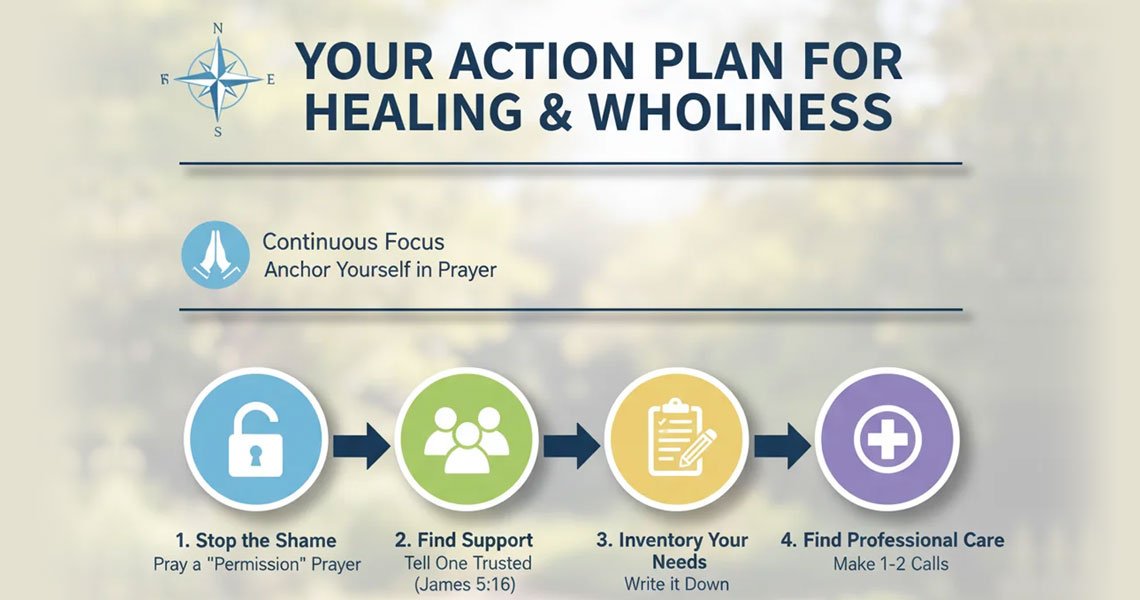
🧭 Your Action Plan for Healing and Wholeness
If you are reading this and feel a gentle nudge that it might be time to seek help, please know that this is a sign of strength, not failure. This simple plan is structured to break through the shame and isolation so you can take that crucial first step.
| Step | Action | Focus |
| Continuous Focus | Anchor Yourself in Prayer: Make prayer a daily, non-negotiable part of this process. Pray for wisdom in choosing a counselor, courage to share your struggle, and the ability to receive God’s peace daily. | Spiritual Foundation |
| 1. Stop the Shame | Pray a “Permission” Prayer: Honestly tell God, “I am hurting, and I can’t fix this on my own. I ask for your wisdom and strength as I seek help.” Thank Him that seeking professional help is a wise act of stewardship. | Internal Breakthrough |
| 2. Find Support | Tell One Trusted Person: Confide in one safe, mature Christian friend, family member, or church leader. Ask them to be your prayer partner and check in on you. (See James 5:16) | Relational Transparency |
| 3. Inventory Your Needs | Write it Down: On a piece of paper or in your phone, write down 3-5 specific ways your struggle is affecting your life right now (e.g., “I cry every day,” “I can’t focus on work,” “I snap at my spouse”). This prepares you for the first conversation with a professional. | Psychological Clarity |
| 4. Find Professional Care | Make 1-2 Calls: Use the resources listed below to find a Christian counselor or a therapist who respects your faith. View the first appointment as a simple consultation. | Practical Healing |
🌟 Trusted Resources for Christian Counseling
When you are ready for Step 4, here are some recommended places to begin your search for a faith-friendly mental health professional:
Directories (Find a Licensed Therapist)
- Christian Counselors Network (CCN) / Focus on the Family: Offers a robust, searchable database of licensed therapists who have signed a Statement of Faith. They also offer a free consultation call with one of their caring ministry counselors for initial guidance.
- American Association of Christian Counselors (AACC): This is the world’s largest Christian counseling association. Their Christian Care Connect tool allows you to search for providers by location, specialty, and insurance.
- Psychology Today (Christian Filter): While not exclusively Christian, their popular directory allows you to filter licensed therapists in your area by the “Christian” or “Faith-Based” orientation.
Online & Telehealth Services (Virtual Counseling)
- MyCounselor.Online: This professional practice offers faith-based counseling and is trained in Neuroscience-Informed Christian Counseling. They are a great option for virtual, specialized care. (Affiliate Note: Inquire about their partner program.)
- Wellspring Counseling: Another organization that offers both in-person and online services with Christian therapists who share core values. (Affiliate Note: They also appear to have an affiliate program.)
Biblical Counseling and Support
- Christian Counseling & Educational Foundation (CCEF): A resource for those seeking Biblical Counseling (a form of discipleship-based help that focuses on the sufficiency of Scripture). They offer a directory, books, and educational resources.
- Mental Health Grace Alliance: This non-profit provides free, faith-based workbooks and training for mental health support groups (called “Grace Groups”). This is an excellent option for finding a local or virtual support community.
Don’t wait for your spiritual struggles to overwhelm your psychological health, or vice versa. You are a beloved creation of God, and He deeply desires your wholeness. When you intentionally integrate both faith and therapy, you are walking in the strength to become the whole, healthy, and effective person He designed you to be.